Historical Timeline, 1990 - 2011
| 1990 - 1999 |
THE FIRST GULF WAR AND WEAPONS INSPECTIONS |
Invasion of Kuwait, US Military Operations, UNSCOM and No-Fly Zones, Cheney "Quagmire" Comment, Oil-for-Food, UNMOVIC |
2000-
Feb. 2003 |
WEAPONS INSPECTIONS |
UN Weapons Inspections, "Axis of Evil", UN Resolution 1441, Secretary of State Powell at UN |
| Mar.-Dec. 2003 |
START OF THE US-IRAQ WAR |
Operation Iraqi Freedom, US Takes Baghdad, UNAMI, Hussein Captured |
| 2004 |
YEAR ONE - US-IRAQ WAR
|
Abu Ghraib, Iraqi Interim Government, Operation Phantom Fury: Securing Fallujah, WMD Search Ends |
| 2005 |
YEAR TWO |
Elections, Operation Lightning, Trial of Hussein Begins, Haditha Killings |
| 2006 |
YEAR THREE |
New Iraqi Government, Al-Zarqawi Killed, Iraq Study Group Report, Hussein Hanged |
| 2007 |
YEAR FOUR |
US Troop Surge, Iraq War Is "Civil War", Bush Vetoes Withdrawal Legislation, British Transfer Control of Basra to Iraq |
| 2008 |
YEAR FIVE |
Iraq Attacks Decline, Iraq Calls for US Withdrawal Timetable, Iraq Sets US Troop Withdrawal Date, Oversight Agency Cites "Massive Waste" in Reconstruction
|
| 2009 |
YEAR SIX |
US Hands over Green Zone Control to Iraq, US Embassy in Iraq Opens, Remaining Non-US Coalition Forces Leave Iraq, Obama Announces End of Combat Mission in Iraq by Aug. 31, 2010, Deadliest Attack of 2009 |
| 2010 |
YEAR SEVEN |
Multi-National Force-Iraq Becomes United States Forces-Iraq, Official End to US Combat Operations in Iraq, Wikileaks Publishes Classified US Military Logs on the War in Iraq |
| 2011 |
YEAR EIGHT |
Iraqi Leaders and al-Sadr Debate US Troop Departure, New US Defense Secretary Leon Panetta Makes First Trip to Iraq, United States Declares Official End to War in Iraq with Final Troop Drawdown |
|
|
THE FIRST GULF WAR AND WEAPONS INSPECTIONS 1990 - 1999
Invasion of Kuwait, US Military Operations, UNSCOM and No-Fly Zones, Cheney "Quagmire" Comment, Oil-for-Food, UNMOVIC
Back to Top |
| DATES |
EVENTS |
| 1990
Invasion of Kuwait |
"Hussein accused neighboring Kuwait in July, 1990, with flooding world oil markets, causing oil prices to decrease and threatening Iraq-s attempts to boost its war-torn economy. On Aug. 2, 1990, some 120,000 Iraqi troops invaded Kuwait, and Hussein declared its annexation."
Columbia Encyclopedia  Sixth Edition, 2001-2005, "Iraq," www.bartleby.com, Mar. 28, 2007 Sixth Edition, 2001-2005, "Iraq," www.bartleby.com, Mar. 28, 2007 |
|
On July 25, 1990, US Ambassador to Iraq, April Glaspie, tells Saddam Hussein, "I admire your extraordinary efforts to rebuild your country. I know you need funds. We understand that and our opinion is that you should have the opportunity to rebuild your country. But we have no opinion on the Arab-Arab conflicts, like your border disagreement with Kuwait."
New York Times "Excerpts from Iraqi Document on Meeting with the US Envoy," Sep. 23, 1990 |
|
"Aug. 2, 1990 - The United Nations Security Council convenes an emergency session at the request of Kuwait and the United States, and votes 14-0 (with Yemen abstaining) to condemn the invasion and to demand that Iraq withdraw immediately and unconditionally [UN Resoultion 660]...
Aug. 6, 1990 - UN Security Council imposes trade embargo [UN Resolution 661] on Iraq in a 13-0 vote, with Cuba and Yemen abstaining."
CNN "The Unfinished War: A Decade Since Desert Storm," www.cnn.com, Apr. 4, 2007 |
|
| 1990 - 1991
US Military Operations |
"Regarding Iraq's actions as a threat to a vital interest of the US...President George Bush ordered warplanes and ground forces to Saudi Arabia after obtaining King Fahd's approval...
Operation Desert Shield, the US military deployment to first defend Saudi Arabia grew rapidly to become the largest American deployment since the Southeast Asia Conflict. The Gulf region was within US Central Command's (CENTCOM) area of responsibility. Eventually, 30 nations joined the military coalition arrayed against Iraq, with a further 18 countries supplying economic, humanitarian, or other type of assistance...
On 17 Jan. 1991, when it became clear that Saddam would not withdraw, Desert Shield became Desert Storm...
After a 38-day air campaign, the Desert Sabre ground offensive began with allied forces sweeping through Iraqi defenses. The Iraqi army was crushed after a mere 100 hours. Iraqi troops--tired, hungry and war-weary from six months of economic blockade and more than a month of relentless allied bombing--surrendered by the thousands."
GlobalSecurity.org "Operation Desert Shield," "Operation Desert Storm," www.globalsecurity.org, Apr. 16, 2007 |
|
| 1991
UNSCOM and No-Fly Zones |
On Apr. 2, 1991, the UN Security Council passes UN Resolution 687 requiring Iraq to "unconditionally accept" the destruction, removal or rendering harmless all "chemical and biological weapons" and to not "acquire or develop nuclear weapons or nuclear-weapons-usable material;" creating the United Nations Special Commission (UNSCOM) to verify the elimination of Iraq's chemical and biological weapons programs; and mandating that the International Atomic Energy Agency (IAEA) verify elimination of Iraq's nuclear weapons program.
United Nations http://daccessdds.un.org, Apr. 4, 2007 |
|
On Oct. 11, 1991, the UN Security Council passes Resolution 715 requiring Iraq to submit to UNSCOM and IAEA long-term monitoring of Iraqi WMD programs and approving detailed plans called for in UN Resolutions 687 and 707 for long-term monitoring.
United Nations http://daccessdds.un.org, Apr. 4, 2007 |
|
"...[T]wo no-fly zones, one in the north and another in the south of Iraq, were unilaterally created by the US, Britain and France soon after the 1991 Gulf War. Iraq was banned from using all aircraft, including helicopters, in the air exclusion zones.
The Northern Zone was established in Apr. 1991 after Baghdad mobilised helicopter gunships to quell a Kurdish uprising."
BBC "Containment: The Iraqi No-Fly Zones," http://news.bbc.co.uk, Mar. 28, 2007 |
|
| Apr. 1993
Bush Assassination Attempt |
"In Apr. 1993, former President George Bush visited Kuwait to commemorate the victory over Iraq in the Persian Gulf War. During Bush's visit, Kuwaiti authorities arrested 17 people allegedly involved in a plot to kill Bush using a car bomb.
The United States sent various personnel to Kuwait to investigate the alleged assassination attempt. Based on interviews of the alleged coconspirators, forensic examinations of the explosive devices, and intelligence reports, the United States Government concluded that Iraq was behind the attempted car bombing. In response, on June 26, 1993, President Clinton ordered a cruise missile strike against an Iraqi Intelligence Service (IIS) building in Baghdad."
FBI "The FBI Laboratory: An Investigation into Laboratory Practices and Alleged Misconduct in Explosives-Related and Other Cases (Apr. 1997)," www.usdoj.gov, Apr. 5, 2007 |
|
| 1994
Cheney's "Quagmire" Comment and Saddam Hussein Becomes Prime Minister |
"Q: Do you think that US or UN forces should have moved into Baghdad?
Cheney: No.
Q: Why not?
Cheney: Because if we'd gone to Baghdad we would have been all alone. There wouldn't have been anybody else with us. There would have been a US occupation of Iraq. None of the Arab forces that were willing to fight with us in Kuwait were willing to invade Iraq.
Once you got to Iraq and took it over, took down Saddam Hussein's government, then what are you going to put in its place? That's a very volatile part of the world, and if you take down the central government of Iraq, you could very easily end up seeing pieces of Iraq fly off: part of it, the Syrians would like to have to the west, part of eastern Iraq -- the Iranians would like to claim, they fought over it for eight years. In the north you've got the Kurds, and if the Kurds spin loose and join with the Kurds in Turkey, then you threaten the territorial integrity of Turkey.
It's a quagmire if you go that far and try to take over Iraq.
The other thing was casualties. Everyone was impressed with the fact we were able to do our job with as few casualties as we had. But for the 146 Americans killed in action, and for their families -- it wasn't a cheap war. And the question for the president, in terms of whether or not we went on to Baghdad, took additional casualties in an effort to get Saddam Hussein, was how many additional dead Americans is Saddam worth? Our judgment was, not very many, and I think we got it right."
Dick Cheney Interview with the American Enterprise Institute, Apr. 15, 1994
[See YouTube video footage from this interview: http://www.youtube.com/watch?v=6BEsZMvrq-I] |
|
May 1994 - "President Saddam Hussein of Iraq will assume the position of Prime Minister himself, replacing Ahmed Hussein Khudayir al-Samarral, the Iraqi news agency reported today.
Citing an official Government statement...the change was necessary because United Nations sanctions imposed on Iraq after it invaded Kuwait in 1990 have damaged the country's economy, the agency said."
New York Times "Iraqi Leader Assumes Post," May 30, 1994 |
|
| Apr. 14, 1995
Oil-for-Food |
"On 14 Apr. 1995, acting under Chapter VII of the United Nations Charter, the Security Council adopted resolution 986, establishing the 'oil-for-food' programme, providing Iraq with another opportunity to sell oil to finance the purchase of humanitarian goods, and various mandated United Nations activities concerning Iraq.
The programme, as established by the Security Council, is intended to be a 'temporary measure to provide for the humanitarian needs of the Iraqi people, until the fulfillment by Iraq of the relevant Security Council resolutions, including notably resolution 687 of 3 Apr. 1991.'"
Office of the Iraq Programme Oil-for-Food "About the Programme," www.un.org, Mar. 28, 2007 |
| 1996
UN Resolutions and CIA Coup Attempt |
"12 June 1996 - UN Resolution 1060 and Resolutions 1115, 1134, 1137, 1154, 1194, and 1205. Demands that Iraq cooperate with UNSCOM and allow inspection teams immediate, unconditional, and unrestricted access to facilities for inspection and access to Iraqi officials for interviews. UNSCR 1137 condemns Baghdad's refusal to allow entry to Iraq to UNSCOM officials on the grounds of their nationality and its threats to the safety of UN reconnaissance aircraft."
CIA "Iraq's Weapons of Mass Destruction Programs," Oct. 2002
|
"1996 June - The CIA recruits officers within Saddam's inner circle to help in a military coup d'État. The plotters were told that the US would recognize them as Iraq's new leaders. They were given special mobile phones with direct lines to the CIA.
But Saddam was ready. A special unit of Iraqi intelligence had studied every coup of the 20th century and they penetrated this one. Saddam's agents burst into homes across Baghdad and tortured and executed hundreds of officers.
Then Saddam's agents found the CIA's phones. An Iraqi intelligence officer placed a call. A US agent answered. He was told, 'Your men are dead. Pack up and go home.'"
PBS "The Long Road to War: Chronology," www.pbs.org, Mar. 29, 2007 |
|
| Dec. 1998
Desert Fox |
"In Dec., [1998] Saddam ends Iraqi cooperation with UNSCOM and accuses the UN of espionage. On Dec. 15, UNSCOM Chairman Richard Butler reports that the Iraqis are refusing to cooperate with inspectors and the next day, President Clinton -- on the eve of the House impeachment vote -- orders Operation Desert Fox, a four-day bombardment of key Iraqi military installations. It is conducted without UN Security Council approval."
PBS "The Long Road to War: Chronology," www.pbs.org, Mar. 29, 2007
|
| Dec. 17, 1999
UNMOVIC |
On Dec. 17, 1999, the UN Security Council passes Resolution 1284 which establishes "as a subsidiary body of the Council, the United Nations Monitoring, Verification and Inspection Commission (UNMOVIC) which replaces the Special Commission [UNSCOM]."
United Nations http://daccessdds.un.org, Apr. 16, 2007
|
WEAPONS INSPECTIONS 2000 - Feb. 2003
UN Weapons Inspections, "Axis of Evil", UN Resolution 1441, Secretary of State Powell at UN
Back to Top |
| DATES |
EVENTS |
| Feb. 11, 2000
UN Weapons Inspections |
Iraq announces that United Nations weapons inspectors would not be allowed back into Iraq to reinstate a disarmament program halted on the eve of American and British air strikes in Dec. 1998.
New York Times   "Iraq Says It Will Not Allow UN Arms Inspectors to Return," Feb. 11, 2000 "Iraq Says It Will Not Allow UN Arms Inspectors to Return," Feb. 11, 2000 |
| Oct.-Dec. 2000
UN and Iraqi Oil |
On Oct. 30, 2000, members of the UN Security Council's Iraqi sanctions committee decide to allow Iraq to receive oil-export payments in euros, rather than dollars.
CNN "UN to Let Iraq Sell Oil for Euros, Not Dollars," Oct. 30, 2000 |
|
Dec. 1, 2000, Iraq temporarily stops exporting oil, reacting to a United Nations refusal to grant Iraq control over certain oil reserves.
Radio Free Europe/Radio Liberty "Iraq: Timeline 1991-2005," www.rferl.org, Mar. 30, 2007 |
|
| Feb. 2001
Iraq Bombed |
"Britain, US carry out bombing raids to try to disable Iraq's air defence network. The bombings have little international support."
BBC "Timeline: Iraq," news.bbc.co.uk, Mar. 29, 2007 |
| Nov. 26, 2001
US Threatens Iraq |
President Bush states: "If anybody harbors a terrorist, they're a terrorist. If they fund a terrorist, they're a terrorist. If they house terrorists they're terrorists...If they develop weapons of mass destruction, that will be used to terrorize nations, they will be held accountable. And, as for Mr. Saddam Hussein, he needs to let inspectors back in his country to show us that he is not developing weapons of mass destruction."
George W. Bush "President Welcomes Aid Workers Rescued from Afghanistan," www.whitehouse.gov, Nov. 26, 2001 |
| Jan. 29, 2002
"Axis of Evil" |
In his 2002 State of the Union address, President Bush describes Iraq, Iran, and North Korea as the "axis of evil": "States like these, and their terrorist allies, constitute an axis of evil, arming to threaten the peace of the world....And all nations should know: America will do what is necessary to ensure our nation's security."
George W. Bush Jan. 29, 2002 |
| Mar. 28, 2002
Beirut Declaration |
The Arab League holds a summit that results in a summit communique, the Beirut Declaration: "The communique calls for Iraq to comply with all relevant UN Security Council resolutions, and demands the immediate lifting of sanctions.
But it also includes an explicit rejection of military action against Iraq, warning that an attack on one Arab nation will be considered an attack on all Arab nations."
Betsy Pisik "Arabs Unite on Peace Offer," Washington Times, Mar. 29, 2002 |
| Sep. 12, 2002
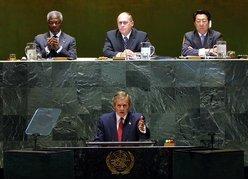
President Bush at the UN |
President Bush states in a speech to the General Assembly of the United Nations: "If Iraq's regime defies us again, the world must move deliberately, decisively to hold Iraq to account. We will work with the UN Security Council for the necessary resolutions. But the purposes of the United States should not be doubted. The Security Council resolutions will be enforced -- the just demands of peace and security will be met -- or action will be unavoidable."
George W. Bush "President Remarks at the United Nations General Assembly," www.whitehouse.gov, Sep. 12, 2001 |
 |
|
| Oct. 10-11, 2002
US Joint Resolution |
The US Senate and the US House of Representatives authorize the use of force in Iraq in Section Three of the Joint Resolution to Authorize the Use of United States Armed Forces Against Iraq:
"AUTHORIZATION. The President is authorized to use the Armed Forces of the United States as he determines to be necessary and appropriate in order to
(1) defend the national security of the United States against the continuing threat posed by Iraq; and
(2) enforce all relevant United Nations Security Council Resolutions regarding Iraq."
Joint Resolution to Authorize the Use of United States Armed Forces Against Iraq 36 KB  Oct. 10-11, 2002 Oct. 10-11, 2002
[See the breakdown of the Oct. 2002 Congressional Votes Authorizing the Iraq War.]
|
| Nov. 8, 2002
UN Resolution 1441 |
The United Nations Security Council approves Resolution 1441 giving Iraq "a final opportunity to comply with its disarmament obligations under relevant resolutions of the Council."
|
| Jan. 9, 2003
UN Finds No "Smoking Gun" in Iraq |
Dr. Hans Blix, Executive Chairman of the UN Monitoring, Verification and Inspection Commission (UNMOVIC), comments that, though the weapons inspectors had not found a "smoking gun" in Iraq, there was no guarantee that prohibited weapons and activities did not exist.
United Nations "Notes for Briefing the Security Council," www.un.org, Jan. 9, 2003 |
|
| Jan. 28, 2003
US: Iraq to Disarm |
President Bush, in his 2003 State of the Union address, talks of disarming Iraq: "The United States will ask the UN Security Council to convene on Feb. the 5th to consider the facts of Iraq's ongoing defiance of the world...But let there be no misunderstanding: If Saddam Hussein does not fully disarm, for the safety of our people and for the peace of the world, we will lead a coalition to disarm him."
George W. Bush "President Delivers 'State of the Union,'" www.whitehouse.gov, Jan. 28, 2003 |
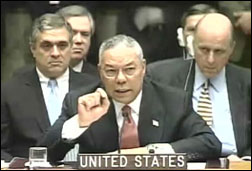
| Feb. 5, 2003
Secretary of State Powell at UN |
|
START OF THE US-IRAQ WAR Mar.-Dec. 2003
Operation Iraqi Freedom, US Takes Baghdad, UNAMI, Hussein Captured
Back to Top |
| DATES |
EVENTS |
| Mar. 7, 2003
US, UK, Spain Draft Resolution |
A draft resolution by the US, Britain and Spain, as amended by the UK, declares that 'Iraq will have failed to take the final opportunity afforded by resolution 1441 (2002) unless, on or before Mar. 17, 2003, the [UN Security] Council concludes that Iraq has demonstrated full, unconditional, immediate and active cooperation.' Consequently the draft seeks approval for military action. The draft is withdrawn on Mar. 17, 2003 after it became clear that it would not have passed.
GlobalSecurity.org "Documents Related to Iraq," www.globalpolicy.org, Apr. 16, 2007 |
| Mar. 17, 2003
UN Withdraws Staff in Iraq; Bush Gives Saddam Warning |
UN Secretary-General Kofi Annan orders all UN inspectors and support staff, humanitarian workers and UN observers along the Iraq-Kuwait border to evacuate Iraq after US threats to launch war.
After failing to secure UN authorization to use force to disarm Iraq, President Bush gives Saddam 48 hours to step down or face war.
CBS News "Weapons Inspectors Leave Iraq," Mar. 18, 2003 |
| Mar. 18, 2003
Coalition of the Willing |
The US State Department names 30 countries which are prepared to be publicly associated with the US action against Iraq. There are 15 additional countries providing assistance, such as over-flight rights, but which do not want to declare support.
The coalition list includes countries which are providing troops, over-flight or basing rights, logistical support or assistance with reconstruction efforts. But the State Department admits that only a few of these countries, notably Britain and Australia, are providing any major military presence in the Gulf.
Steve Schifferes "US Names 'Coalition of the Willing,'" BBC News, Mar. 18, 2003 |
| Mar. 19, 2003
Operation Iraqi Freedom |
President George W. Bush addresses the American people at 10:15 p.m. EST to announce the beginning of a "broad and concerted campaign" to disarm Iraq. The campaign is known as Operation Iraqi Freedom.
Radio Free Europe/Radio Liberty "Iraq: Timeline 1991-2005," www.rferl.org, Apr. 6, 2007 |
| [Read President Bush's Mar. 19, 2003 address to the nation.] |
|
| Mar. 21, 2003
Shock and Awe |
"The US and its allies launched a massive aerial assault against Iraq...
The campaign was intended to instill 'shock and awe' among Iraq's leaders, and it was directed at hundreds of targets in Iraq, officials said."
CNN "'Shock and Awe' Campaign Underway in Iraq," Mar. 22, 2003 |
| Apr. 9, 2003
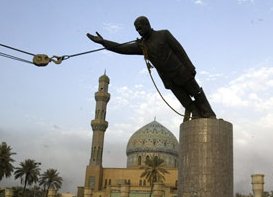
US Takes Baghdad |
US-led forces take control of Baghdad. Iraqi civilians cheer on advancing US troops in a celebration of the end of Saddam Hussein's oppressive 24-year-long rule. Iraqis, aided by US Marine, topple a huge statue of Saddam in Baghdad's main square.
NPR "Chronology: A Timeline of Events in the Current Iraqi Conflict," www.npr.org, Apr. 30, 2007 |
 |
|
| May 1, 2003
"Major Combat Operations in Iraq Have Ended" |
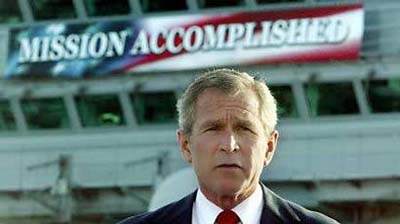 |
After landing in a Navy S-3B Viking onto the aircraft carrier USS Abraham Lincoln, President Bush gives a victory speech in front of a banner stating "Mission Accomplished," announcing that "major combat operations in Iraq have ended."
Jesse Singal and Christine Lim "Victory Lap," Time.com, May 2003 |
|
| May 22, 2003
Economic Sanctions End |
The UN Security Council adopts resolution 1483 that ends economic sanctions in Iraq, sets out the responsibilities of the UN in Iraq, and supports the establishment of a transitional Iraqi administration.
USINFO "UN Security Council Ends Economic Sanctions on Iraq," usinfo.state.gov, Apr. 30, 2007 |
| July 13, 2003
Iraqi Governing Council |
The Iraqi Governing Council, established by and served under the US-led Coalition Provisional Authority (CPA), meets for the first time in Baghdad. The 25-member governing council has the power to name ministers and approve the 2004 budget. However, L. Paul Bremer, chief US civilian administrator for Iraq, retains the last word on Iraqi affairs.
Radio Free Europe/Radio Liberty "Iraq: Timeline 1991-2005," www.rferl.org, Apr. 6, 2007 |
| Aug. 14, 2003
UNAMI |
The UN Security Council passes Resolution 1500 establishing the United Nations Assistance Mission for Iraq (UNAMI) as a one-year follow-through mission in the wake of the Oil-for-Food programme handover on 21 Nov. 2003.
United Nations daccessdds.un.org, Apr. 10, 2007 |
| Aug. 29, 2003
Mosque Bombed, Shiite Leader Killed |
A massive car bomb explodes outside the Imam Ali Mosque, killing one of Shiite Islam's top clerics, Ayatollah Mohammad Baqir al-Hakim, and 124 others, is the deadliest attack in Iraq since the regime of Saddam Hussein fell.
CNN "Najaf Bombing Kills Shiite Leader, Followers Say," Aug. 30, 2003 |
| Aug.-Oct. 2003
International Organizations Bombed |
On Aug. 19, 2003, a truck bomb explodes outside the UN headquarters building in Baghdad. It is one of the worst attacks on UN personnel in the organization's history.
On Oct. 27, 2003, suicide bombings target International Red Cross (ICRC) headquarters, killing 12 people. This bombing is the first suicide attack on the neutral Swiss-based ICRC in its 140-year history.
CNN "Truck Bomb Kills Chief UN Envoy to Iraq," Aug. 20, 2003; BBC, "Red Cross Cuts Iraq Operations," Nov. 8, 2003 |
| Dec. 13, 2003
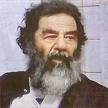
Hussein Captured |
American soldiers capture Saddam Hussein in a raid on an isolated farm near Tikrit. The former Iraqi president was found, haggard and disoriented but alive, hiding at the bottom of an 8-foot-deep so-called "spider hole," camouflaged with bricks and dirt and covered with polystyrene and a carpet.
Susan Sachs and Kirk Semple "Ex-Leader, Found Hiding in Hole, Is Detained Without a Fight," New York Times, Dec. 14, 2003 |
 |
|
THE US-IRAQ WAR - YEAR ONE 2004
Abu Ghraib, Iraqi Interim Government, Operation Phantom Fury: Securing Fallujah, WMD Search Ends
Back to Top |
| DATES |
EVENTS |
| Jan. 17, 2004
500 US Troops Dead |
500 US troops have been killed in the Iraq war, 346 of them in hostile situations. 361 US troops have been killed, 231 in hostile action, since President Bush declared the end of major combat operations on May 1, 2003.
Alphonso Van Marsh "US: Powerful Bomb Kills 5 in Iraq," CNN, Jan. 17, 2004 |
| Mar. 31, 2004
Fallujah: Four Contractors Killed |
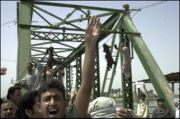 |
Four Blackwater private security contractors are ambushed and killed. Their burned bodies are dragged through the streets and then hanged from a bridge over the Euphrates River.
Jeffrey Gettleman "Enraged Mob in Falluja Kills 4 American Contractors," New York Times, Mar. 31, 2004 |
|
| Mar. 2004
Taguba Report on Abu Ghraib |
|
| Apr. 18, 2004
Spain Pulls Troops |
Spain's new prime minister, Jose Luis Rodriguez Zapatero, prepares to pull the 1,300 Spanish troops stationed in Iraq. The previous Spanish government's support for the war, and its handling of the Madrid bombings, were thought to have caused Zapatero's electoral victory.
BBC "Spain PM Orders Iraq Troops Home," Apr. 18, 2004 |
| Apr. 2004
Abu Ghraib |
A number of photographs surface which depict abuse and torture of Iraqi prisoners held in US custody at the Baghdad Central Detention Center, formerly known as Abu Ghraib Prison. This follows a Mar. 2004 announcement by the US Army that six soldiers were being investigated for allegedly abusing about 20 prisoners at the prison.
GlobalSecurity.org "Abu Ghurayb Prison," www.globalpolicy.org, Apr. 30, 2007
[Note: See more about US involvement at the Abu Ghraib prison in our question What happened at Abu Ghraib prison after the US military took over the facility in 2003?] |
| June 24, 2004
US and al-Sadr Ceasefire |
Shiite cleric Muqtada al-Sadr declares a unilateral cease-fire with US forces in the Baghdad district of Sadr City and offers to help police ensure safety in the area. This is a shift for al-Sadr who had previously launched an uprising throughout the Shiite heartland south of Baghdad.
FOX News "Sadr's Militia Declares Cease-Fire," June 26, 2004 |
| June 2004
Iraqi Interim Government |
The United Nations endorses the reestablishment of Iraqi sovereignty and the interim constitution takes effect, with Iyad Allawi, a Shiite, as prime minister and Sheik Ghazi Ajil al-Yawar, a Sunni, as president.
Saddam Hussein and 11 other former high-ranking Iraqi officials are formally turned over to the new government and are arraigned.
The Columbia Encyclopedia Sixth Edition, 2001-2005 "Iraq," www.bartleby.com, Apr. 9, 2007 |
| Sep. 8, 2004
Over 1,000 US and 1,129 Coalition Troops Dead |
The total of Americans killed in the 18-month-old war passes the 1,000 mark at 1,002. And, according to a CNN tally, 1,129 coalition troops from 15 nations have died in Iraq.
Alphonso Van Marsh "US Death Toll in Iraq Passes 1,000," CNN, Sep. 18, 2004 |
| Oct. 2004
Inconsistant Iraqi Death Count |
Forty-six prominent British figures, including military men, ex-diplomats and bishops, write to Prime Minister Tony Blair urging an inquiry into civilian deaths in Iraq. The Oct. 29, 2004 Lancet study claims that nearly 100,000 died after the invasion. Other groups put the figure at 15,000. Blair says the most accurate estimate is from the Iraqi Ministry of Health - with a total of between 3,853 and 15,517 for Apr. to Oct. 2004.
BBC "Demands Grow for Iraq Death Count," Dec. 8, 2004
[Note: See more about the complexity in accurately reporting casualties in our question What are the difficulties in reporting casualties in Iraq?] |
| Nov. 2004
Operation Phantom Fury: Securing Fallujah |
On Nov. 8, an estimated 10,000-15,000 American troops launch Operation Phantom Fury to secure the city of Fallujah. US Military officials announce that, by Nov. 15, 38 US troops, six Iraqi soldiers and an estimated 1,200 insurgents had been killed. On Nov. 16, US military officials announce that American troops had secured Fallujah.
GlobalSecurity.org "Operation al-Fajr (Dawn): Operation Phantom Fury," www.globalsecurity.org, Apr. 23, 2007 |
| Dec. 2004
WMD Search Ends |
The hunt for biological, chemical and nuclear weapons in Iraq ends nearly two years after President Bush ordered US troops to disarm Saddam Hussein.
Charles A. Duelfer, who led the weapons hunt in 2004, is back in Washington wrapping up his work. According to the CIA, he will not be replaced in Baghdad.
Dafna Linzer "Search for Banned Arms In Iraq Ended Last Month," Washington Post, Jan. 12, 2005 |
THE US-IRAQ WAR - YEAR TWO 2005
Elections , Operation Lightning, Trial of Hussein Begins, Haditha Killings
Back to Top |
| DATES |
EVENTS |
| Jan. 30, 2005
Elections |
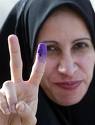 |
Iraq's first competitive election in a half-century takes place, marking an historic breakthrough for the democratic principle in Iraq. 60 percent of eligible voters turn out, with the following ethnic breakdown: strong voter turnout among the Shiites and Kurds, who together comprise over 80 percent of the population, with a poorer turnout among the Sunni Arabs.
Tony Karon "Making Sense of Iraq's Vote," Time.com, Jan. 31, 2005 |
|
| Apr. 11, 2005
Shia and Sunni Demonstrate |
Tens of thousands of supporters of Shia cleric Muqtada al-Sadr Mar. in Baghdad to denounce the US presence in Iraq and call for a speedy trial of Saddam Hussein on the second anniversary of his overthrow. Sunni Muslims were also urged to demonstrate: "Many of our brothers, including Sunnis, have welcomed the call and will take part," said a spokesman for al-Sadr. "We hope it's going to be one million people strong."
Al Jazeera "Shia Protest Over US Presence in Iraq," Apr. 11, 2005
[Read about the differences between the Sunni and the Shia in our question What are the different religious groups in Iraq?] |
| Apr. 2005
Iraqi President and Prime Minister Established |
In the middle of increasing violence, the Iraqi parliament selects Kurdish leader Jalal Talabani as president and Ibrahim Jaafari, a Shia, as prime minister.
BBC "Timeline: Iraq," http://news.bbc.co.uk, Apr. 9, 2007 |
| May 29, 2005
Operation Lightning |
In the largest anti-insurgent operation by Iraqi soldiers to date, 40,000 members of the Iraqi army and security forces launch Operation Lightning in a bid to crack down on insurgents in Baghdad. The operation is the first phase of a nationwide assault intended to put Iraqi troops on the offensive against the insurgents. Operation Lightning is vital to the new Iraqi government, as well as the US-led coalition, since its outcome could indicate whether the Iraqis are ready to take over security operations in their country.
Stratfor "Iraq: The Politics of Operation Lightning," June 3, 2005 |
| June-Oct. 2005
New Kurdistan President and Iraqi Constitution |
On June 14, Iraqi Kurdistan Region, the only official region in Iraq, swears in Massoud Barzani as regional president. A draft constitution is finalized on Aug. 28 by a Shia and Kurdish bloc, but is not endorsed by Sunni representatives.
On Oct. 15, Iraqi voters approve a new constitution, which aims to create an Islamic federal democracy.
BBC "Timeline: Iraq," http://news.bbc.co.uk, Apr. 9, 2007 |
| Oct. 19, 2005
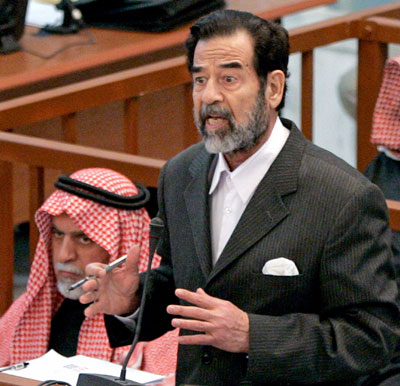
Trial of Hussein Begins |
Almost two years after being captured, former Iraqi President Saddam Hussein goes on trial for crimes against humanity committed two decades ago during his reign. In the three-hour hearing, Saddam and his seven co-defendants are charged with the 1982 murder of 148 Shia men in the town of Dujail. Saddam entered a not guilty plea.
PBS "Judge Delays Saddam Trial Until Nov.," Oct. 19, 2005 |
 |
|
| Oct. 2005
2,000 US Troops and 25,000 Iraqis Dead |
As the US marks the 2,000th military death in Iraq, the Senate holds a minute of silence and the names of the dead are read out on the floor of the House of Representatives. President Bush has warned Americans to brace themselves for more casualties, saying no-one should underestimate the difficulties ahead. Unofficial estimates put Iraqi civilian deaths since the start of the war at about 25,000.
BBC "US Death Toll in Iraq Hits 2,000," Oct. 26, 2005 |
| Nov. 19, 2005
Haditha Killings |
Eight US Marines are charged with the deaths of unarmed Iraqi civilians in the Al Anbar town of Haditha. Up to 24 Iraqi non-combatant local residents were killed by the Marines on Nov. 19 during a hunt for a roadside bomber. It is alleged that the Iraqis were massacred by Marines in retribution for an insurgent attack earlier in the day.
NPR "Timeline: Iraq," http://news.bbc.co.uk, Apr. 24, 2007 |
| Dec. 15, 2005
Vote for New Iraqi Parliament |
Iraqis vote for a parliament that will choose a full-term four-year government. 275 seats are at issue with 288 competing party lists. High Sunni voter turnout and a low level of violence were significant elements of this election.
John Fisher Burns "Iraq Votes," PBS "Online News Hour," Dec. 15, 2005 |
THE US-IRAQ WAR - YEAR THREE 2006
New Iraqi Government, Al-Zarqawi Killed, Iraq Study Group Report, Hussein Hanged
Back to Top |
| DATES |
EVENTS |
| Jan. 20 - Apr. 22, 2006
New Iraqi Government |
Shia-led United Iraqi Alliance emerges as the winner of Dec.'s parliamentary elections, but the party fails to gain an absolute majority. Months of political deadlock ends on Apr. 22 when newly re-elected President Jalal Talabani asks Shia compromise candidate Nouri al-Maliki to form a new government.
BBC "Timeline: Iraq," http://news.bbc.co.uk, Apr. 9, 2007 |
| June 7, 2006
Al-Zarqawi Killed |
Abu Musab al-Zarqawi, the mastermind behind hundreds of bombings, kidnappings and beheadings in Iraq, is killed by an airstrike north of Baghdad. Zarqawi's death is the most significant triumph for the US-led military coalition in Iraq since the 2003 capture of Saddam Hussein.
Ellen Knickmeyer and Jonathan Finer "Insurgent Leader Al-Zarqawi Killed in Iraq," Washington Post, June 8, 2006 |
| July 27, 2006
International Compact With Iraq |
Iraq and the United Nations announce the formal launch of the International Compact With Iraq. This Compact, jointly shared by the Government of Iraq and the UN, with the support of the World Bank, will bring together the international community and multilateral organizations to help Iraq achieve its national vision.
United Nations "United Nations, Iraq Jointly Announce Launch of Five-Year International Compact," Press Release, July 27, 2006 |
| July-Aug. 2006
UN Average: 100 Iraqis Die Each Day |
The number of Iraqi civilians killed in July and Aug. hits 6,599, a record-high number that is far greater than initial estimates suggest, the United Nations said. According to the UN, violent civilian deaths in July reached an unprecedented high of 3,590, an average of more than 100 a day. The Aug. toll was 3,009.
Nick Wadhams "UN: Civilian Death Toll in Iraq Climbs," Associated Press, Septmber 21, 2006 |
| [Read the UN Assistance Mission for Iraq (UNAMI) 1 July-31 Aug. 2006 Human Rights report regarding the number of Iraqis killed.] |
|
| Nov. 5, 2006
Hussein Sentenced to Death |
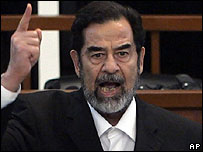 |
Saddam Hussein is sentenced to death by hanging for crimes against humanity. Saddam shouted "God is great" as chief judge Raouf Abdul Rahman read out the court's verdict. Saddam was tried over the deaths of more than 148 Shia Muslim men in reprisal for a 1982 assassination attempt on the Iraqi leader in the town of Dujail.
Guardian Unlimited "Saddam Sentenced to Hang," Nov. 5, 2006 |
|
| Nov. 21, 2006
Iraq and Syria Restore Diplomatic Ties |
The foreign ministers of Iraq and Syria jointly confirm at a press conference in Baghdad that their two countries have restored diplomatic ties. The two countries severed diplomatic relations 24 years ago over Syria's siding with Iran in the 1980-88 Iran-Iraq War.
Radio Free Europe/Radio Liberty "Iraq, Syria Establish Diplomatic Relations," Nov. 21, 2006 |
| Dec. 6, 2006
Iraq Study Group Report |
A long-awaited report by the Iraq Study Group (ISG), "The Way Foward - A New Approach, paints a bleak picture of the situation in Iraq. The 10-member, bipartisan group says the situation in Iraq is "grave and deteriorating" and could provoke a slide into chaos. The report, handed to President Bush and Congress, lays out 79 recommendations to try to pull Iraq back from the brink.
Jackie Northam "Iraq Study Group: US Policy 'Not Working,'" NPR, Dec. 6, 2006 |
| [Read our News Release with a summary of the ISG report, pro and con reactions to it, and links to related information] |
|
| Dec. 30, 2006
Hussein Hanged |
Saddam Hussein, the former Iraqi president, is hanged. The execution takes place shortly before 6 am (03:00 GMT) at an Iraqi miltary facility in northern Baghdad.
Al Jazeera "Saddam Hanged at Dawn," Dec. 30, 2006 |
| [Read our News Release about Hussein's execution, which includes links to details of Saddam's life, politics, and US relations.] |
|
THE US-IRAQ WAR - YEAR FOUR 2007
US Troop Surge, Iraq War Is "Civil War", Bush Vetoes Withdrawal Legislation, British Transfer Control of Basra to Iraq
Back to Top |
| DATES |
EVENTS |
| Jan. 10, 2007
US Troop Surge |
 |
President Bush announces the deployment of five additional US Army brigades to Iraq to support Iraqi army operations in and around Baghdad, and two Marine brigades to Anbar province to assist in operations against al-Qaeda. With this deployment of more than 20,000 additional US forces, US troop levels in Iraq will exceed 160,000 in the next several months.
USINFO "Bush Sending Additional US Forces To Support Iraqi Troops," Jan. 10, 2007; "US Developing Backup Plans if Iraq Surge Does Not Show Results," Feb. 7, 2007 |
| [Read the Jan. 2007 White House strategy in the "Highlights of the Iraq Strategy Review" and the "Fact Sheet: The New Way Forward in Iraq"] |
|
| Jan. 2007
Over 34,000 Iraqi Civilians Dead |
|
|
Feb. 2007
Iraq War Is "Civil War" |
The 2007 US National Intelligece Estimate (NIE) on Iraq says that, although "the term 'civil war' does not adequately capture the complexity of the conflict in Iraq," the term "accurately describes key elements of the Iraqi conflict."
|
| Feb. 26, 2007
New Iraqi Oil Legislation and Iraqi Ministry Bombing |
Iraq's cabinet approves draft oil legislation that will allow the government to manage the country's vast oil resources and to distribute oil revenue throughout the country.
In a severe security breach, a bomb explodes inside a government ministry in Baghdad, narrowly avoiding the assassination of, Adel Abdul Mahdi, one of Iraq's two vice presidents.
Joshua Partlow and Ernesto Londono "Iraq's Cabinet Backs Contentious Oil Measure," Washington Post, Feb. 27, 2007 |
| Mar. 27, 2007
Ba'ath Party Returns |
The Iraqi government approves a draft law allowing former members of Saddam Hussein's outlawed Ba'ath Party to return to their official posts.
Al Jazeera "New Iraqi Law to Lift Ban on Former Baathists," Mar. 27, 2007 |
| [Read our question What is the Ba'ath Party?] |
|
| Apr. 11, 2007
ICRC Issues Report |
|
| Apr. 2007
Baghdad Wall |
The US military in Baghdad start building a 12-foot-high, three-mile-long wall separating an historic Sunni enclave from Shiite neighborhoods in a radical new strategy to quell the widening sectarian violence in the area.
Edward Wong and David S. Cloud "US Erects Baghdad Wall to Keep Rival Sects Apart," New York Times, Apr. 21, 2007 |
 |
|
| May 1, 2007
Bush Vetoes Withdrawal Legislation |
President Bush vetoes congressional legislation (HR 1591, "US Troop Readiness, Veterans' Care, Katrina Recovery, and Iraq Accountability Appropriations Act, 2007") requiring the start of troop withdrawals from Iraq by Oct. 1, 2007. He reasons: "It makes no sense to tell the enemy when you plan to start withdrawing."
New York Times "Citing Rigid' Deadline, Bush Vetoes Iraq Bill" by David Stout and Sheryl Gay Stolberg, May 1, 2007 |
|
| Oct. 2007
Troop Buildup Peaks at 170,000 |
Troop buildup in Iraq peaks at 170,000.
Associated Press "A Timeline of Iraq War, Troop Levels," Apr. 8, 2008 |
|
| Aug. 29, 2007
al-Sadr Cease-Fire |
 |
Shiite cleric Moqtada al-Sadr publicly orders his Mahdi Army militia to "freeze" operations for up to six months following a day of Shiite-against-Shiilte gunfire that killed 49 people in the holy city of Karbala.
Washington Post "Sadr Orders 'Freeze' on Militia Actions" by Joshua Partlow and Saad Sarhan, Aug. 30, 2007 |
|
| Dec. 17, 2007
British Transfer Control of Basra to Iraq |
British forces hand over military control of the Basra Province to the Iraqi government. 4,500 British troops remain in Iraq and focus on training Iraqi forces.
BBC "UK Troops Return Basra to Iraqis," Dec. 17, 2007 |
|
| Dec. 31, 2007
2007 Deadliest Year |
2007 was the deadliest year for American troops in Iraq. The 899 American troop deaths in 2007 surpassed 2004 when 850 US soldiers were killed.
The Guardian "2007 Is America's Deadliest Year in Iraq" by Allegra Stratton, Dec. 31, 2007 |
|
THE US-IRAQ WAR - YEAR FIVE 2008
Iraq Attacks Decline, Iraq Calls for US Withdrawal Timetable, Iraq Sets US Troop Withdrawal Date, Oversight Agency Cites "Massive Waste" in Reconstruction
Back to Top |
| DATES |
EVENTS |
| Jan. 12, 2008
Ba'ath Reinstate-
ment |
Iraq's parliament unanimously passes a law allowing thousands of former Ba'ath party members to apply for reinstatement in the civil service and military. The legislation also allows pensions to be given to additional senior members still banned from public life.
The law makes a distinction between two categories of Ba'ath party officials who have been barred from state employment since 2003. Only senior party leaders who were in the top five of the party's 10 levels and who implemented the oppressive policies of Saddam's government would remain subject to the ban. Middle-ranking officials and those in the bottom five levels of the party structure would be able to resume government jobs.
Al Jazeera "Iraq Eases Law Against Baathists," Jan. 13, 2008
[Read our question What is the Ba'ath Party?] |
|
| Feb. 22, 2008
al Sadr Extends Ceasefire |
Shiite cleric Moqtada al-Sadr suspends Mahdi Army activities for a second six-month period. "'This extension of his Aug. 2007 pledge of honor to halt attacks is an important commitment that can broadly contribute to further improvements in security for all Iraqi citizens,' the military said in a statement, according to the AP [Associated Press]. 'It will also foster a better opportunity for national reconciliation.'"
Public Broadcasting Service (PBS) "In Iraq, Al-Sadr Extends Cease-fire Order to Militia," Online NewsHour website, Feb. 22, 2008 |
|
| Mar. 11, 2008
Iraq Attacks Decline |
|
| Mar. 24, 2008
4,000 US Troops Dead |
The number of dead US soldiers in Iraq reaches 4,000.
Reuters "Four U.S. Soldiers Killed in Iraq, Death Toll 4,000," Mar. 24, 2008 |
| [Read our page on the Deaths from the War in Iraq.] |
|
|
July 10, 2008
Petraeus
Commands CENTCOM,
Odierno to MNF-I |
The US Senate confirms US Army General David Petraeus as commander of US Central Command (CENTCOM) and Army General Ray Odierno to succeed Petraeus as commander of the Multinational Force in Iraq (MNF-I).
US Department of Defense (DoD),  "Senate Confirms Petraeus, Odierno," Press Release, July 10, 2008 "Senate Confirms Petraeus, Odierno," Press Release, July 10, 2008 |
|
| July 14, 2008
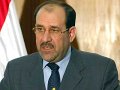
Iraq Calls for US Withdrawal Timetable |
Iraq's Prime Minister Nouri al-Maliki is quoted at an Arab ambassador reception saying that "the negotiations with the US party are continuing, and the current orientation is to reach a memorandum of understanding for the evacuation of the US forces or a memorandum of understanding for scheduling their withdrawal."
Asharq Al-Awsat "Iraq Proposes Time Frame for US Withdrawal- Official," July 14, 2008 |
 |
|
| July 16, 2008
US Troop Surge Ends |
The US military "surge" into Iraq that began on Jan. 10, 2007 has ended. 150,000 US troops remain, about 15,000 more than before the buildup began.
Reuters "Iraq Troop Surge Ends; 150,000 Left" by Lolita C. Baldor, July 16, 2008 |
|
|
Nov. 27, 2008
Iraq Sets US Troop Withdrawal Date |
|
|
Dec. 2008
Oversight Agency Cites "Massive Waste" in Reconstruction |
|
THE US-IRAQ WAR - YEAR SIX 2009
US Hands over Green Zone Control to Iraq, US Embassy in Iraq Opens, Remaining Non-US Coalition Forces Leave Iraq
Obama Announces End of Combat Mission in Iraq by Aug. 31, 2010, Deadliest Attack of 2009
Back to Top |
| DATES |
EVENTS |
| Jan. 1, 2009
US Hands over Green Zone Control to Iraq |
|
| Jan. 5, 2009
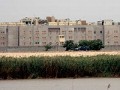
US Embassy in Iraq Opens |
The largest and one of the most expensive US embassies ever built opens in Baghdad, Iraq. Originally estimated to cost $592 million, the final tally for construction was $736 million. The embassy has over 20 buildings and houses over 1,200 employees on 104 acres, 10 times bigger than the UN complex in New York. The fortress-like compound was built with high security in mind and is surrounded by concrete walls topped with razor wires.
Campbell Robertson "New U.S. Embassy Dedicated in Baghdad as Bombs Explode Elsewhere," New York Times, Jan. 5, 2009 |
 |
|
| Jan. 31, 2009
Iraq Holds First Nationwide Elections Since 2005 |
Iraq held its first nationwide elections since Jan. 30, 2005. Voters cast ballots in provincial elections that included about 400 different parties with more than 14,000 candidates seeking 440 empty seats. Prime Minister Nouri al-Maliki's Dawa Party scored a sweeping victory.
With a 51% voter turnout, election day was reported to be peaceful and smooth. Sunni participation increased at 40%, up from the 2% Sunni turnout due to a Sunni boycott of elections in 2005.
Kate Stanton "Provinicial Elections Test Iraq's Move Towards Democracy," "Online NewsHour," Public Broadcasting Service (PBS) website, Feb. 3, 2009 |
|
| Feb. 27, 2009
Obama Announces End of Combat Mission in Iraq by Aug. 31, 2010 |
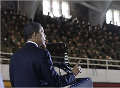 |
President Barack Obama announces that "by August 31, 2010, our combat mission in Iraq will end." His plan includes withdrawing most of the 42,000 troops in Iraq by the summer of 2010. Between 35,000-50,000 troops will stay in Iraq to train and advise Iraqi security forces, hunt terrorist cells, and protect American civilian and military personnel. These "transitional forces" will leave by 2011 in accordance with the Status of Forces Agreement signed on Nov. 27, 2008.
Peter Baker "With Pledges to Troops and Iraqis, Obama Details Pullout," New York Times, Feb. 27, 2009 |
| [Read our question Was the 2008 Status of Forces Agreement (SOFA) to withdraw US troops from Iraq by 2011 a good agreement?] |
|
| May 1, 2009
UK Ends Six Years of Combat Operations in Iraq |
British troops end six years of combat operations with the lowering of a British regimental flag to mark the handover to US forces in Basra and a memorial ceremony for the 179 UK troops who died during the conflict. The majority of Britain's 3,700 troops will leave Iraq by the end of May 2009. Around 400 troops will stay to help train naval officers and assist with patrols around oil platforms.
Michael Settle "Brown Hails 'Success' as UK Soldiers Withdraw," The Herald, May 1, 2009 |
| [See our page on the Coalition Forces in Iraq.] |
|
| June 30, 2009
Iraq Declares a National Holiday as US Troops Withdraw |
"U.S. combat troops, under agreement with the Iraqi government [Status of Forces Agreement (SOFA)], abandoned the country’s cities today amid public celebrations and private concerns over Iraq’s future security.
The government declared today a national holiday and official cars were decorated with streamers and flowers... In a televised ceremony in Baghdad, Prime Minister Nuri al- Maliki guaranteed the government could keep its citizens safe. 'Those who think that Iraqis are not able to protect their country and that the withdrawal of foreign forces will create a security vacuum are making a big mistake...'
The American pullout is a step toward a complete U.S. withdrawal from all of Iraq at the end of 2011. The schedule was set under an agreement reached last November between the Bush administration and the Iraqi al-Maliki’s government. President Barack Obama wants to reduce U.S. troop strength in Iraq, currently at 131,000, to no more than 50,000 by August, 2010." |
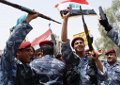
Iraqi police celebrate withdrawal of US troops from Basra on June 30, 2009. Source: www.nytimes.com |
| Daniel Williams "U.S. Combat Troops Exit Iraqi Cities Amid Celebration," Bloomberg.com, June 30, 2009 |
| [Read our question: Was the 2008 Status of Forces Agreement (SOFA) to withdraw US troops from Iraq by 2011 a good agreement?] |
|
| June 30, 2009
Iraq Begins Major Oil and Gas Auction |
"Iraq will auction off eight giant oil and gas fields... in its first major tender since 2003, giving oil firms a foothold in a country that may hold some of the world's largest untapped energy reserves.
Private jets flew representatives from leading global firms like Exxon Mobil and Total into Baghdad, a city still ringed by blast walls and gripped by violence, to place their bids for the 20-year development contracts.
The companies are wading into a morass of controversy surrounding the deals, which some Iraqi lawmakers condemn as illegal and which even some within the state-run oil industry have criticised for selling Iraq's vast oil wealth short.
Over six years after Saddam Hussein's ouster was supposed to unleash Iraq's oil potential, the auction marks the first real centre-stage moment for the Oil Ministry, under growing pressure to boost disappointing output around 2.4 million barrels a day.
Iraq has proven oil reserves of 115 billion barrels, the world's third largest, but the true amount of black gold sitting beneath Iraq's desolate deserts could be far greater...
Firms from the countries that launched the 2003 invasion, which triggered years of chaos and bloodshed, will be neither favoured nor disadvantaged, [Iraqi officials] say."
Missy Ryan "Iraq Launches Historic Oil and Gas Auction," guardian.co.uk, June 29, 2009 |
|
July 2009
Remaining Non-US Coalition Forces Leave Iraq |
| "Two days from now [July 31, 3009], there will no longer be any other nations with troops in Iraq - no 'multi' in the Multi-National Force. As Iraqi forces have increasingly taken the lead, the United States is the last of the 'coalition of the willing' that the Bush administration first brought together in 2003.
That is partly because the Iraqi Parliament left suddenly for summer recess without voting to extend an agreement for the British military to keep a residual training force of 100 soldiers in Iraq. As a result, those troops must withdraw to Kuwait by Friday, according to a British diplomat, who declined to be identified in keeping with his government’s practice.
As for the other two small remnants of the coalition, the Romanians and Australians, the Australians will be gone by July 31, too, and the Romanians left last Thursday [July 23]...
Many coalition contributors lost soldiers in Iraq. Britain suffered the most, with 179 killed, since its troops were deployed in the restive southern province of Basra. The other 37 contributors lost a total of 139 soldiers. American fatalities have exceeded 4,300."
Rod Nordland and Timothy Williams "Iraq Forces Soon to Be a Coalition of One," www.nytimes.com, July 29, 2009 |
|
Aug. 19, 2009
Deadliest Attack of 2009 |
| "At least 95 people have been killed and hundreds injured by a series of co-ordinated bomb attacks in Baghdad today. In the deadliest attack in Iraq this year, and the most audacious one in the capital for several more, truck and car bombs and mortar fire were directed against the main centres of power. The targets included the ministries of finance, foreign affairs, health and housing, as well as the Parliament and Cabinet buildings...
Blast walls surrounding the Foreign Ministry compound, which might have limited the devastation, were removed two months ago. The move was part of a process of 'normalisation' by the Iraqi government, after US troops withdrew from Iraqi cities on June 30...
Today is the sixth anniversary of a truck bombing that hit the United Nations compound in Baghdad, killing 22 people including special envoy Sergio Vieira de Mello."
Oliver August "Scores Dead as Baghdad Rocked by Series of Massive Explosions," www.timesonline.co.uk, Aug. 19, 2009 |
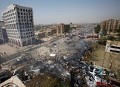
Iraqi Foreign Ministry building, left, at the site of a massive bomb attack on Aug. 19, 2009. Source: www.washingtonpost.com |
|
THE US-IRAQ WAR - YEAR SEVEN 2010
Multi-National Force-Iraq Becomes United States Forces-Iraq, Official End to US Combat Operations in Iraq,
Wikileaks Publishes Classified US Military Logs on the War in Iraq
Back to Top |
| DATES |
EVENTS |
Jan. 1, 2010
Multi-National Force-Iraq Becomes United States Forces-Iraq |
"The first of January will bring in more than a new year for U.S. troops serving in Iraq; it will also bring them a new name, as the moniker Multi-National Forces-Iraq (MNF-I) is replaced by the new term, U.S. Forces-Iraq.
The dropping of the name 'multi-national' removes one of the last reminders to the 'coalition of the willing' that the Bush administration used to describe the 2003 allied invasion of Iraq and the subsequent effort to stabilize the country.
The long-awaited name change reflects the reality that, since July, only U.S. troops have continued to serve in Iraq...
The move also consolidates U.S. forces into a new command structure ahead of the planned troop reductions scheduled for 2010. By the end of August 2010, the current force levels of 110,000 U.S. troops will be reduced to 50,000 troops who will be serve in a new training mission.
Under the security agreement between the United States and Iraq, all U.S. forces are supposed to be out of Iraq by the end of 2011."
Luis Martinez "The Name Change in Iraq," abcnews.go.com, Jan. 1, 2010 |
Aug. 24, 2010
US Withdraws More Than 90,000 Combat Troops in Iraq |
"The U.S. military said on Tuesday [Aug. 24, 2010] it had cut its troops in Iraq to below 50,000 before an Aug. 31 deadline set by President Barack Obama as he seeks to keep a promise to end the war.
The withdrawal of 90,000-plus soldiers, 40,000 vehicles and 1.5 million items from radios to generators has progressed steadily over the past months, despite continuing violence and a political impasse five months after an inconclusive election.
The U.S. military commander in Iraq, General Raymond Odierno, said troop numbers were at around 49,700 and would stay at that level for the next year before a full withdrawal by the end of 2011 agreed in a bilateral security pact...
The end of U.S. combat operations in Iraq comes 7-1/2 years after the invasion launched by former President George W. Bush to topple Saddam Hussein."
Reuters "U.S. Troops in Iraq below 50,000 as Combat Ends," www.reuters.com, Aug. 24, 2010 |
| Aug. 31, 2010
Official End to US Combat Operations
in Iraq |
"...[T]onight, I am announcing that the American combat mission in Iraq has ended. Operation Iraqi Freedom is over, and the Iraqi people now have lead responsibility for the security of their country.
This was my pledge to the American people as a candidate for this office. Last February, I announced a plan that would bring our combat brigades out of Iraq, while redoubling our efforts to strengthen Iraq’s Security Forces and support its government and people.
That’s what we’ve done. We’ve removed nearly 100,000 U.S. troops from Iraq. We’ve closed or transferred to the Iraqis hundreds of bases. And we have moved millions of pieces of equipment out of Iraq.
This completes a transition to Iraqi responsibility for their own security. U.S. troops pulled out of Iraq’s cities last summer, and Iraqi forces have moved into the lead with considerable skill and commitment to their fellow citizens. Even as Iraq continues to suffer terrorist attacks, security incidents have been near the lowest on record since the war began. And Iraqi forces have taken the fight to al Qaeda, removing much of its leadership in Iraqi-led operations...
Going forward, a transitional force of U.S. troops will remain in Iraq with a different mission: advising and assisting Iraq’s Security Forces, supporting Iraqi troops in targeted counterterrorism missions, and protecting our civilians. Consistent with our agreement with the Iraqi government, all U.S. troops will leave by the end of next year. As our military draws down, our dedicated civilians -- diplomats, aid workers, and advisors -- are moving into the lead to support Iraq as it strengthens its government, resolves political disputes, resettles those displaced by war, and builds ties with the region and the world."
Barack Obama, JD "Remarks by the President in Address to the Nation on the End of Combat Operations in Iraq," www.whitehouse.gov, Aug. 31, 2010 |
|
Sep. 2010
GAO Report Finds Iraq Has Budget Surplus of $52.1 Billion |
 |
(Click to enlarge)
Table 1: Iraq's Estimated Annual Surpluses and Cumulative Budge Surplus, through 2009
Source: "Iraq Has a Cumulative Budget Surplus, Offering the Potential for Further Cost-Sharing," www.gao.gov, Sep. 2010 |
"Since 2003, the United States has reported obligating about $642 billion for U.S. military operations in Iraq and provided about $24 billion for training, equipment, supplies, facility construction, and other services for Iraqi security forces...
GAO believes that Congress should consider Iraq’s available financial resources when it reviews the administration’s fiscal year 2011 budget request and other potential future budget requests for additional funds to train and equip Iraqi security forces. Iraq generated an estimated cumulative budget surplus of $52.1 billion through December 2009."
"Iraqi-U.S. Cost-Sharing: Iraq Has a Cumulative Budget Surplus, Offering the Potential for Further Cost-Sharing," 1.75 MB  Government Accountability Office (GAO), Sep. 2010 Government Accountability Office (GAO), Sep. 2010 |
Oct. 22, 2010
Wikileaks Publishes Classified US Military Logs on the War in Iraq |
"Wikileaks has released almost 400,000 secret US military logs, which suggest US commanders ignored evidence of torture by the Iraqi authorities.The documents also suggest 'hundreds' of civilians were killed at US military checkpoints after the invasion in 2003.
And the files show the US kept records of civilian deaths, despite previously denying it. The death toll was put at 109,000, of whom 66,081 were civilians...
Speaking to reporters in Washington on Friday [Oct. 22, 2011], US Secretary of State Hillary Clinton said she condemned the disclosure and suggested the leaks put lives at risk.
However, Wikileaks said it was confident that the documents - published in a heavily censored form - contain 'no information that could be harmful to any individual'.
Wikileaks says it expects to launch legal proceedings as a result of information contained in the documents."
BBC "Huge Wikileaks Release Shows US 'Ignored Iraq Torture'," www.bbc.co.uk, Oct. 23, 2010 |
THE US-IRAQ WAR - YEAR EIGHT 2011
Iraqi Leaders and al-Sadr Debate US Troop Departure,
New US Defense Secretary Leon Panetts Makes First Trip to Iraq, United States Declares Official End to War in Iraq with Final Troop Drawdown |
| DATES |
EVENTS |
Jan. 13, 2011
Iraqi Leaders and al-Sadr Debate US Troop Departure |
"Iraqi politicians face the contentious question this year of whether to ask U.S. troops to stay beyond an end-of-2011 deadline for their departure. That decision has become far more complicated with the return to Iraq of anti-American cleric Muqtada al-Sadr...
The case for an extension centers around concerns that Iraqi forces may not be ready to keep security. Many Sunnis want U.S. troops to stick around for their protection, fearing domination by the Shiite majority. Kurds see the Americans as a guarantee of their autonomous region in the north. And some in the party of Shiite Prime Minister Nouri al-Maliki also want the U.S. forces to stay.
But al-Sadr, a Shiite who came home last week from nearly four years in voluntary exile in Iran, is a formidable obstacle. He immediately put the government on notice that he and his movement, which is a pivotal member of the ruling coalition, will not tolerate any lingering American troop presence."
Qassim Abdul-Zahra Rebecca Santana "Sadr Return Complicates US Troop Presence in Iraq," abcnews.go.com, Jan. 13, 2011 |
July 10, 2011
New US Defense Secretary Leon Panetta Makes First Trip to Iraq |
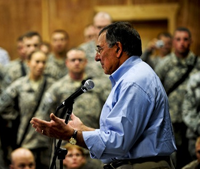 |
Defense Secretary Leon Panetta at Camp Victory in Iraq, in an undated photo.
Source: "World Week Ahead: Panetta Visits Iraq," www.pbs.org, July 11, 2011; photo by US Air Force Tech. Sgt. Jacob N. Bailey |
"Leon Panetta arrived in Iraq on Sunday [July 10, 2011] on his first trip there as U.S. defense secretary, saying he would press Baghdad on the future U.S. military presence...
The United States is scheduled to withdraw all of its remaining 46,000 troops from Iraq by the end of this year, under the terms of a bilateral security pact -- despite US and Iraqi military concerns about expected gaps in security.
Panetta, who is fresh from a trip to Afghanistan, made hopeful remarks to Congress last month that Iraq's government might eventually ask some U.S. forces to remain beyond 2011. But he was cautious in his comments to reporters in Afghanistan, just before departing for Iraq.
Asked whether he would encourage Iraq to ask some US forces to stay, Panetta said: 'I'll encourage them to make a decision so that we'll know where we're going.'
US officials say that the clock is ticking and that the longer the Iraqis wait, the more difficult it becomes for Washington to say 'yes'."
Reuters "New U.S. Defence Chief in Iraq, to Press on Drawdown," af.reuters.com, July 10, 2011 |
|
Dec. 15, 2011
United States Declares Official End to War in Iraq with Final Troop Drawdown |
"After nearly nine years of war, the loss of more than 100,000 lives and hundreds of billions of dollars spent, the U.S. military mission in Iraq has formally ended…
Defense Secretary Leon E. Panetta and other top U.S. officials conducted a low-key ceremony on a military base at the Baghdad airport Thursday, furling the flag to signal the official conclusion of one of the most divisive wars in American history…
‘With the departure of the remaining U.S. forces within these last few days to the end of the year, we salute the fact that Iraq is now fully responsible for directing its own path to future security and future prosperity,’ Panetta told about 200 troops and a few Iraqi officials during the 45-minute ceremony…
Only two U.S. bases and about 4,000 troops remain in Iraq, the rear guard of a force that was more than 170,000 strong at the height of the war and once controlled hundreds of bases. The last of the troops will leave this weekend, officials said. About 200 U.S. military personnel will stay in Baghdad to administer arms sales and other limited military exchanges as members of the U.S. diplomatic mission…
The security of civilians is now the responsibility of Iraqi troops and police, visible on virtually every major street in Baghdad, searching passing cars and patrolling avenues. More than a year ago, they took over security responsibilities after U.S. forces withdrew from Iraq's cities…
Of the 16,000 employees expected to be working at the embassy next year, only 1,500 to 2,000 will be State Department staffers. Many of the rest will be security contractors…
Even so, U.S. involvement in Iraq is not over. This week, Iraqi President Nouri Maliki met with Obama in Washington, where they pledged to proceed with a new, vaguely defined ‘equal partnership’ between the nations. Iraq has requested more U.S. military training, the details of which will be negotiated next year. Meanwhile, American military and civilian trainers with the Office of Security Cooperation at the U.S. Embassy train Iraqis to use warplanes and tanks purchased from the U.S.”
Los Angeles Times "'Iraq War 'Not in Vain,' Panetta Says at Withdrawal Ceremony: After Nine Years, the U.S. Military Mission in Iraq Formally Ends,” latimes.com, Dec. 15, 2011
|
|
| RECOMMENDED to you...
|
|
1
|
|
2
|
|
3
|
|
4
|
|
5
|
|
6
|
|
7
|
|
8
|
|
9
|
|
10
|
|
11
|
|
12
|
|
13
|
|
14
|
|
15
|
|



 Top 10 Pro & Con Arguments